 Call us now:
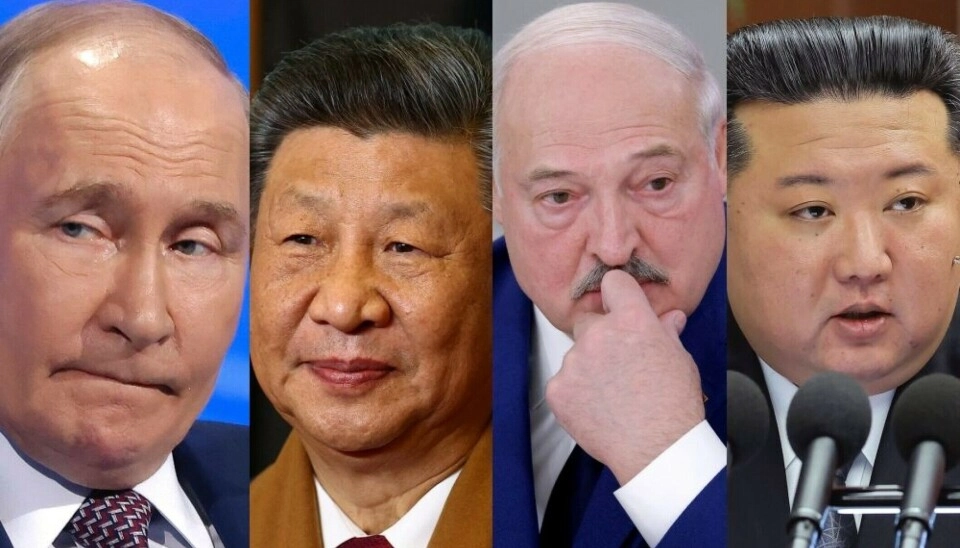
Dictatorship countries is the term for when a single person, party, army, monarchy or a small group of people hold power with very little accountability to the public. The latest list includes countries like North Korea, China, Eritrea, Saudi Arabia, Afghanistan, Myanmar, Belarus, Russia and Cuba, though that list varies depending on the year and source. The best way to understand these lists is to look at who controls the elections, the courts, the media, the police and other security services and the most basic civil liberties.
In This Article
- How Dictatorship Countries Are Identified Today
- Dictatorship Vs. Autocracy
- Current Dictatorships And Their Leaders
- Examples Of Dictatorship By Regime Type
- What Life Is Like Under Authoritarian Rule
- World Freedom Maps And Year-By-Year Changes
- Not Free Countries Since 2020
- Disputed Territories And De Facto Authorities
- How To Read Any List Of Countries With Dictators
- Key takeaways
- Frequently asked questions
- Conclusion
How Dictatorship Countries Are Identified Today
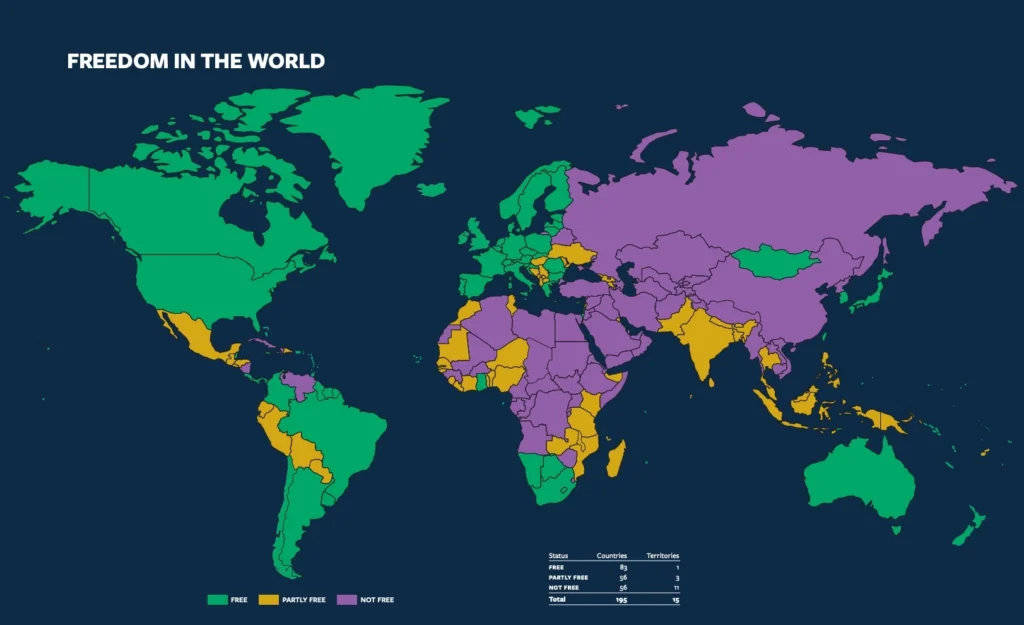
A country is generally thought to be a dictatorship if the necessary institutions are in place but are not able to limit the power of the leader or his inner circle. Sometimes the scores from Freedom House, a “Not Free” classification are used as a proxy, since they measure political rights and civil liberties rather than just ensuring elections according to law or the constitution.
An example of a dictatorship example might be one where all of the courts, the state media, the election commission, and the police take their orders from the same individual. A government could have the appearance of something other than a dictatorship; a republic can still be ruled by a single man, while a monarchy may allow some input from its citizens yet not be called a democracy. What matters most is who wields the power, not what the country claims its government to be.
Dictatorship Vs. Autocracy
The concept of autocracy is the broader one, and can refer to either a single person or a small group that runs the government. The term dictatorship usually refers to coercive rule with little meaningful accountability, limited constraints on opposition, and little possibility of challenge by the public. There is also an umbrella term “authoritarian regime” which encompasses one-party states, military regimes, monarchies, and personalist regimes.
Some dictator countries have elections and courts, and even call themselves republics. However, none of them are democracies because other parties cannot compete on equal footing, there is no freedom of the press, and there is no way to actually vote out the head of state. A dictatorship can look like a democracy, but it is not required to follow its rules.
Current Dictatorships And Their Leaders
These countries and their leaders make up the list of the world’s most well-known countries and dictators, according to the dictatorships in the world.
- North Korea: Kim Jong Un
- China: Xi Jinping
- Russia: Vladimir Putin
- Belarus: Alexander Lukashenko
- Eritrea: Isaias Afwerki
- Equatorial Guinea: Teodoro Obiang Nguema Mbasogo
- Saudi Arabia: King Salman, Mohammed bin Salman
- Afghanistan: Hibatullah Akhundzada
- Myanmar: Min Aung Hlaing
- Cuba: Miguel Díaz-Canel
- Iran: Ali Khamenei
- Syria: Bashar al-Assad
- Turkmenistan: Serdar Berdimuhamedow
- Tajikistan: Emomali Rahmon
- Vietnam: Communist Party leadership
- Laos: Thongloun Sisoulith
- Nicaragua: Daniel Ortega
- Venezuela: Nicolás Maduro
- Brunei: Sultan Hassanal Bolkiah
- Oman: Sultan Haitham bin Tariq
Current Dictatorships In Asia And The Middle East
Most of the countries with dictators are in Asia and the Middle East and include absolute monarchies, one-party states, and theocratic and military dictatorships. China (Xi Jinping) and North Korea (Kim Jong Un) are particularly noteworthy for the way their parties have seized control of the courts, media, and security services.
This also includes Iran’s system of a supreme leader, Saudi Arabia and its King Salman and powerful Mohammed bin Salman, Qatar, UAE, Oman, Brunei, Syria and Afghanistan, and its leader Hibatullah Akhundzada. They’re all very different from each other, so you’ll want to learn about each one individually rather than in general.
Africa’s Military And Long-Serving Rulers
The dictatorships in Africa tend to be military coups, revolutions led by freedom fighters, or presidents who continue to rule beyond their term limits. Eritrea is run by Isaias Afwerki and is one of the most closed societies. Equatorial Guinea is run by Teodoro Obiang Nguema Mbasogo and is a good illustration of how authoritarianism can become personalized.
Other situations that are more complicated include military juntas or transitions after a military takeover in Sudan, Chad, Mali, Niger, and Burkina Faso, and the extent of political freedom, time in office, and elections in countries such as Rwanda, Uganda, and Cameroon. Some of those are already dated.
Europe And The Americas
A European country that would qualify as a dictatorship example country is Russia, which has developed its political system around concentrating power in the presidency, criminalizing political opposition, and controlling the press, with Vladimir Putin as its figurehead. A comparable but smaller scale situation can be found in Belarus, where the police and electoral system are focused on keeping the regime and Alexander Lukashenko in place.
In the Americas, the only one-party state is Cuba. Then there’s the Nicaraguan government of Daniel Ortega and Venezuelan government of Nicolás Maduro, which are often included in the category of dictatorships due to restrictions on the opposition and independent institutions. Do not list Haiti as a dictatorship; it is simply a provisional government.
Examples Of Dictatorship By Regime Type
It will be helpful to consider examples of regimes that can be dictatorial to help us understand examples of dictatorship better. In a one-party state such as China or Vietnam, the party is responsible for controlling the candidates, the judges, the state institutions and the security forces. In a military junta such as Myanmar or Mali, it is the military chain of command, their authority to declare a state of emergency and the limitation of non-military political engagement.
In an absolute monarchy such as Saudi Arabia or Brunei, the power is held by the royal family; i.e., the power belongs to the institution of the monarchy, not to the party or to the general who won the election. What is the practical implication of this distinction? It means that two countries can both lack democratic oversight but have different ways of maintaining power.
What Life Is Like Under Authoritarian Rule
To most people, authoritarian rule means whether they are allowed to express themselves on the internet, whether the news organisations they consume are legal or not, whether there are opposition parties in politics, whether courts are independent of the government. It means prison, or it means losing your job, or being monitored.
It is police and security services. People can be detained, exiled, stopped from travelling, and interrogated. There can be self-censorship in the media. There can be elections, but no real choice, if the candidates are stopped, the press is controlled, or the judges are afraid to stand up to the regime.
World Freedom Maps And Year-By-Year Changes
This is why we prefer to create freedom maps: Because each country can move up and down the spectrum from Not Free to Partly Free to Free depending on coups, wars, crackdowns, elections, and legislation in that country, from year to year.
The best freedom map / democracy dataset to track dictatorship countries
| Freedom map / dataset | Best for dictatorship countries analysis | Year-by-year change signal | Strengths | Weaknesses |
|---|---|---|---|---|
| Freedom House: Freedom in the World | Identify the current “Not Free” countries and their territory status | Yearly 0–100 score and Free/Partly Free/Not Free designation from 1972 to present | Offers worldwide coverage, plus sub-scores for political rights and civil liberties; often cited in news and policy papers | Annual updates, so it takes a few months for a coup or wartime emergency to register |
| V-Dem Democracy Reports | Count how many types of autocracy exist | Yearly Liberal Democracy Index and Regimes of the World designations from 1789 to present | Contains numerous expert-coded and highly specific indicators; splits electoral autocracy, closed autocracy, and types of democracy | Less convenient to navigate than a map-based solution; requires familiarity with indices and uncertainty ranges to interpret results |
| EIU Democracy Index | Compare various types of regime covered in the news | Yearly 0–10 score and one of these labels: full democracy, flawed democracy, hybrid regime, authoritarian regime | Country rankings; simple categories; useful for summaries and graphs since 2006 | Proprietary methodology makes it less transparent than some academic datasets |
| Our World in Data democracy charts | Display long-run patterns of freedom and autocracy | Annual country-level lines from the V-Dem project and other historical datasets | Charts downloadable; excellent for showing before-and-after snapshots around coups, wars, and reforms | Compiles existing sources, so the definition of freedom and dictatorship depends on which dataset you pull |
| Bertelsmann Transformation Index | Examine state-building and politics in low- and middle-income countries | Scores issued biannually on political transformation, governance, and economic transformation | Focuses on state capacity and quality of governance; useful for assessing why freedoms have changed, not just whether they did | Only includes 137 low- and middle-income countries, not all nations worldwide |
| Polity5 Project | Historical analysis of regimes | Yearly polity score from -10 to +10 for independent states from 1800 through 2018 (and updated for 2020) | One-number index of long-term regime change; useful for academic research | Does not include other aspects of freedom such as civil liberties, media, and repression |
The table above compares the major freedom maps and democracy databases in terms of how well they detect dictatorship countries, how they indicate year-over-year change, and how they describe political rights changes.
Not Free Countries Since 2020
This means that the current list of Not Free countries can also be thought of as a kind of timeline. As we have seen, the political situation in some of these countries could change again in the future if elections, coups, invasions, or territorial changes occur.
Every country that Freedom House has rated Not Free since 2020
| Not Free country | Region | 2020-2024 rating | Primary authoritarian feature | Contextual insight |
|---|---|---|---|---|
| China | East Asia | Rated Not Free in 2020, 2021, 2022, 2023 and 2024 | Authoritarian rule by the Chinese Communist Party, surveillance state, persecution of Uyghur Muslims | Entrenched one-party dictatorship |
| Russia | Eurasia | Rated Not Free in 2020, 2021, 2022, 2023 and 2024 | Manipulated elections, banned opposition, war censorship following Russian invasion of Ukraine | Shows how warfare and repression boost authoritarian strength |
| Iran | Middle East | Rated Not Free in 2020, 2021, 2022, 2023 and 2024 | Unelected mullah leadership, mass arrests of dissidents, screening of candidates | Theocratic dictatorship with restricted elections |
| North Korea | East Asia | Rated Not Free in 2020, 2021, 2022, 2023 and 2024 | Dynasty of Kim family leaders, forced labor camps, no legal opposition parties | Totalitarian dictatorship country |
| Syria | Middle East | Rated Not Free in 2020, 2021, 2022, 2023 and 2024 | Assad dynasty, repression during Syrian Civil War, rule by security forces | Driven by conflict |
| Belarus | Europe | Rated Not Free in 2020, 2021, 2022, 2023 and 2024 | Lukashenko dictatorship, election repression in 2020, jailed opposition | Locking in after an election |
| Myanmar | Southeast Asia | Rated Not Free in 2020, 2021, 2022, 2023 and 2024 | Military coup in 2021, rule by junta, wartime conditions and censorship | Coup alters the timeline |
| Afghanistan | South Asia | Rated Not Free in 2020, 2021, 2022, 2023 and 2024 | Taliban takeover of power in 2021, restriction on rights of women and girls, no nationwide elections | Reason why recent years should be reviewed closely |
| Eritrea | Africa | Rated Not Free in 2020, 2021, 2022, 2023 and 2024 | Single party rule, conscription without time limit, no independent media | Closed state, forced labor |
| Venezuela | Latin America | Rated Not Free in 2020, 2021, 2022, 2023 and 2024 | Maduro government, exclusion of opposition, partisan judiciary | Electoral authoritarianism in Latin America |
This table lists 10 countries that have been rated Not Free in all editions of the annual Freedom in the World report from 2020 to 2024 by Freedom House and provides a short description of the main cause of authoritarianism in each country.
Disputed Territories And De Facto Authorities
Not all of these cases are straightforward countries. Gaza, the West Bank, Transnistria, South Ossetia, Western Sahara, and Russian-controlled parts of Ukraine all raise the question of contested rule, militias, military occupation, foreign backing, and non-recognition. These would not be treated as normal countries.
This is also where a lot of readers get confused. It could be that there is a de facto authority governing the security apparatus, the courts, the tax system, and the borders, but this does not make it a country. Therefore, it is also necessary to distinguish countries from territories controlled by non-state actors, foreign occupiers, or unrecognized regimes.
How To Read Any List Of Countries With Dictators
An astute reader may wonder just what these lists are referring to. Many of these dictator lists are specific to an individual ruler, whereas those from World Population Review and WorldData.info are generally more about the nature of the country itself. The Democracy-Dictatorship Index is based on things such as how leaders are selected (say, through competitive elections), or the presence of a mechanism for peaceful transfer of power.
It’s important to keep in mind that different sources will rank things differently depending on how much they weigh civil rights, elections, legal vs. actual power, etc. No single ranking should be taken as gospel, and you should always pay attention to when the list was compiled, what the criteria are, whether disputed territories are counted, and whether a revolution has occurred since the list was published.
Key takeaways
Categories are inconsistent because the criteria applied include elections, freedom of speech, whether the country is ruled by a dictator, and how much free-market capitalism is permitted. Some examples have extremely strong executives, a weak judiciary, restricted press freedom, and no independent political parties. Types of Dictatorships include one-party dictatorships, military juntas, absolute monarchies, and personalist dictatorships. Borders that are contested or countries that are not considered sovereign must be excluded from a comprehensive study of countries worldwide. Ideally, the study would present the most recent country list and why each country belongs to its respective group, regional subgroup breakdowns, and annual updates on country rankings.
Frequently asked questions
Which countries are currently dictatorships?
These are the countries that are most frequently listed as being run by a dictator, or having an authoritarian regime: North Korea, China, Russia, Belarus, Eritrea, Equatorial Guinea, Saudi Arabia, Afghanistan, Myanmar, Cuba, Iran, Syria, Turkmenistan, Tajikistan, Vietnam, Laos, Nicaragua, Venezuela, Brunei and Oman. But as with most lists of this sort, there is no real agreement on what exactly is meant by the terms, particularly with regards to the degree of power the leader holds, the legitimacy of elections and the existence of basic civil rights.
Is Russia a democracy or dictatorship?
For instance, Russia has elections, a constitution and a variety of state institutions, yet it is generally regarded as an authoritarian state since most of the power is vested in the presidency of Vladimir Putin, there is heavy suppression of the opposition and severe limits on independent media and civil society. Russia may or may not be a dictatorship, depending on your definition, but it certainly isn’t a liberal democracy.
Which country has a dictator?
If I had to pick just one country that would probably be regarded as a dictatorship at the moment, it would be North Korea, which is run by Kim Jong Un and his family, has no national opposition and its citizens have very few rights. Other countries that are also frequently listed are Belarus (run by Alexander Lukashenko), Eritrea (run by Isaias Afwerki) and Equatorial Guinea (run by Teodoro Obiang Nguema Mbasogo).
What are the top 10 dictatorship countries in the world?
A rough top 10 might be: North Korea, China, Russia, Belarus, Eritrea, Equatorial Guinea, Saudi Arabia, Afghanistan, Myanmar and Cuba. They all feature a high degree of control by the ruler and very few constraints on government power. Again, I’m not trying to rank them! This isn’t a definitive list, and you should verify any references before citing this sequence.
What countries have a dictatorship according to Freedom House’s “Not Free” category?
Freedom House’s “Not Free” category on their website includes many countries that have few civil rights and democratic institutions, but this doesn’t give a very specific list of dictators. Several of these countries are currently embroiled in civil wars, or undergoing major political transitions. To narrow it down, you need to look at the extent of the ruler’s power, whether the elections are legitimate, the independence of the judiciary, and the freedom of the press.
Conclusion
Dictatorships in Dictatorship countries are countries where the political power is concentrated in the hands of one person, a political party, military junta, a monarchy or a small group with little or no accountability to the general public. There are different ways that sources classify regimes, but one useful way to think about them is by the current leader, the Freedom House style ratings of freedom, the type of regime, and whether elections or the courts provide a meaningful check on power. The most concise answer to this question is a country list, but the main theme of a dictatorship is the concentration of power in the hands of a leader with a constrained opposition, controlled media, weak rule of law, and a security service that protects the regime. Please recheck time-sensitive information again, especially after coups, elections, wars, leadership changes, or updates to the freedom ratings.