 Call us now:

Gerrymandering is one of the most consequential — and least discussed — forces shaping American elections. Every ten years, after the census, state legislatures redraw electoral district boundaries. When those in power draw lines that entrench their own advantage rather than reflect the actual distribution of voters, the result is gerrymandering. The practice distorts representation, can lock in political control for a decade, and affects which party controls the House of Representatives at the national level. Understanding how it works is essential to understanding why election outcomes in many states feel predetermined before a single vote is cast.
What Is Gerrymandering in Simple Terms?
Gerrymandering is the manipulation of electoral district boundaries to give one political party a structural advantage over another. The term dates to 1812, when Massachusetts Governor Elbridge Gerry signed a redistricting plan that created an oddly shaped district designed to benefit his Democratic-Republican Party. A political cartoonist noted the district’s resemblance to a salamander and merged it with Gerry’s name — gerrymander.
In simple terms: the people drawing the map choose their voters, rather than voters choosing their representatives. By concentrating the opposing party’s voters into as few districts as possible, or spreading them so thin they rarely win anywhere, mapmakers can produce legislative chambers that do not reflect the overall balance of voter preferences in a state.
A state where voters are evenly split between two parties might produce a congressional delegation that is 70% controlled by one side. That gap between votes cast and seats won is the clearest measure of how aggressively a map has been drawn.
The Two Core Techniques: Packing and Cracking
Packing and cracking are the fundamental tools of gerrymandering, and understanding them makes the practice immediately legible.
Packing means concentrating the opposing party’s voters into as few districts as possible. The packed district produces a lopsided win for the opposition — say, 80% to 20% — but wastes the surplus votes. Those excess votes could have been competitive in neighboring districts, but instead they pile up uselessly in one safe seat.
Cracking means splitting the opposing party’s voters across multiple districts where they form a minority in each one. A city that leans heavily toward one party might be divided among four surrounding suburban and rural districts, diluting its political influence across all of them. The result: the city’s voters never constitute a majority anywhere, and their preferred candidates lose repeatedly.
Used together, packing and cracking allow a party that controls the mapmaking process to win a disproportionate share of seats even when the overall vote is relatively balanced. For a creative exploration of how these electoral mechanics play out in practice, the best movies about US elections offer some compelling dramatizations of the stakes involved.
How Does Gerrymandering Affect Elections at the National Level?
The answer to how a state’s gerrymandering can impact government at the national level comes down to the composition of the US House of Representatives. Because House seats are allocated by district within each state, a heavily gerrymandered state can send a congressional delegation that does not reflect its voters’ actual preferences.
When multiple states engage in aggressive partisan gerrymandering simultaneously, the cumulative distortion shapes which party controls the House. This directly affects which legislation passes, which investigations move forward, and which presidential agenda items receive support or obstruction. State-level map drawing, in other words, is national politics by another name.
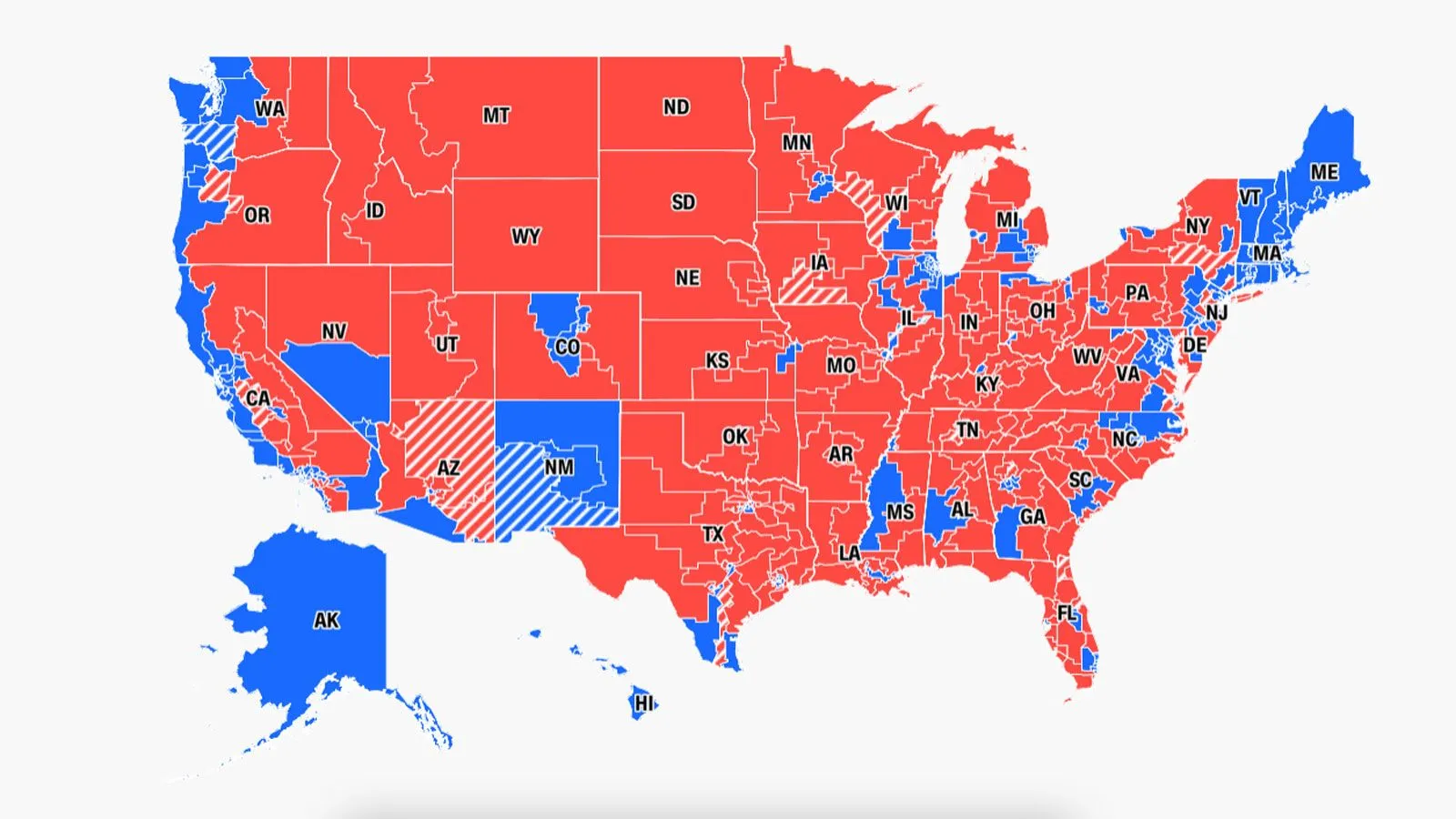
North Carolina, Wisconsin, and Maryland have all been central to major gerrymandering disputes in recent decades. Maps drawn in these states produced House delegations that diverged significantly from statewide voting patterns, affecting the national balance of power in Congress.
Does Partisan Gerrymandering Affect Votes Within States?
Yes, in two ways. First, it shapes which candidates win seats. Second, it shapes which candidates bother to run at all. In a district drawn to be safe for one party, primary elections become the only competitive contest. Candidates who win primaries in heavily gerrymandered safe districts face no meaningful general election competition, which tends to push elected officials toward their party’s base rather than toward the median voter.
This dynamic contributes to polarization beyond gerrymandering’s direct electoral effects. Safe districts produce politicians who are accountable only to primary voters — who tend to be more ideologically committed than the general electorate. The result is more extreme representation and less incentive for compromise.
Is Gerrymandering Legal?
This is where the answer gets complicated. Racial gerrymandering — drawing district lines specifically to dilute the voting power of racial minorities — is illegal under the Voting Rights Act and the Equal Protection Clause of the Fourteenth Amendment. Courts have struck down maps found to discriminate on racial grounds.
Partisan gerrymandering is a different story. In the 2019 case Rucho v. Common Cause, the US Supreme Court ruled that federal courts cannot review partisan gerrymandering claims. The majority held that partisan gerrymandering presents a political question beyond the reach of federal courts. This does not mean partisan gerrymandering is endorsed or encouraged — the Court acknowledged it is “incompatible with democratic principles” — but it placed the remedy outside the federal judiciary’s hands.
State courts remain an avenue for challenges under state constitutional provisions. Several states have seen their maps struck down by state courts, including Pennsylvania, where the state Supreme Court ordered new maps drawn. But the legal landscape varies significantly by state, and the federal door is now closed.
Both Parties Gerrymander — But Not Equally
Do both parties gerrymander? Yes. Republicans and Democrats have both drawn aggressively partisan maps when they control the redistricting process. Maryland’s Democrats and North Carolina’s Republicans have both faced significant legal challenges in recent decades.
However, the geographic distribution of voters creates an asymmetry. Democratic voters tend to cluster in cities, which makes them easier to pack into a small number of districts. Republican voters tend to be more evenly spread across suburban and rural areas, which is naturally better suited to winning more districts. This means that even neutral map-drawing can produce outcomes that favor Republicans somewhat — and intentional Republican gerrymandering can amplify that effect significantly.
Independent redistricting commissions, now used in over a dozen states including California, Michigan, and Arizona, represent the main structural alternative to partisan mapmaking. These bodies remove the direct conflict of interest inherent in letting legislators draw their own districts. Evidence from states with commissions suggests they produce maps that more accurately reflect statewide vote shares. The documentary All In: The Fight for Democracy examines these structural barriers to fair representation in depth.
Why Is Gerrymandering Still Allowed?
The persistence of gerrymandering comes down to the intersection of constitutional design, legal precedent, and political incentives. The Constitution leaves redistricting to the states. Congress has the authority to impose national standards but has not done so in a comprehensive way. Federal courts have withdrawn from partisan gerrymandering review. And the party controlling any given state legislature has an obvious incentive to draw maps that preserve its power.
Reform efforts — independent commissions, algorithmic mapping, court challenges under state constitutions — have made progress in individual states. But no nationwide solution exists. Gerrymandering remains legal as a partisan exercise in most states because the combination of constitutional structure and Supreme Court precedent leaves it there.
Why Gerrymandering Is a Problem for Democratic Representation
The core problem with gerrymandering is that it inverts the basic logic of representative democracy. In a properly functioning system, voters choose their representatives. In a gerrymandered system, representatives effectively choose their voters by shaping the electorate before a single ballot is cast.
When elections are decided by the map rather than by voters, accountability breaks down. Politicians in safe gerrymandered seats face no consequences for ignoring the preferences of the broader electorate. The relationship between public opinion and legislative outcomes weakens. Parties can hold power in state legislatures and congressional delegations for a decade despite losing the overall popular vote — not through policy success, but through cartographic engineering.
This matters for the legitimacy of democratic institutions. When voters perceive that outcomes are predetermined, participation can decline, cynicism rises, and the incentive to engage with the political process diminishes. Understanding how celebrities influence elections and motivate turnout becomes particularly relevant in gerrymandered environments where voters may feel their individual choice is irrelevant.
Redistricting Reform and the Path Forward
The 2020 census triggered another round of redistricting. Several states produced maps that were immediately challenged in courts. Some were struck down and redrawn. The resulting maps for the 2022 and 2024 elections reflected a patchwork — some states with independently drawn maps, others with aggressively partisan ones.
Reform advocates continue to push for federal legislation establishing national redistricting standards, expansion of independent commissions, and stronger enforcement of the Voting Rights Act. Progress has been uneven. But the conversation around gerrymandering has become more public than it was a generation ago, driven by accessible data, better mapping tools, and increased media coverage of redistricting cycles.
Gerrymandering is not inevitable. It is a choice made by those in power. Changing it requires either changing who holds power at the state level or changing the rules under which mapmaking happens — and both paths demand sustained civic engagement over election cycles, not just a single vote.